clock

Watching time, the only true currency // A journal from John B. Roberts

Month: September 2005

  • A recipe for ginger beer

    Sometimes you need to step away from the computer and tech, as I did last night. The kitchen is rarely my milieu, but with a four-ingredient recipe for making ginger beer, I decided it was worth the risk.

    Ginger beer is fantastically tart: think ginger ale squared, with less carbonation. Several weeks ago I clipped a recipe sidebar from a print (!) article in the New York Times about Jamaican foods, and put it to the test. Not your usual morning beverage, but I think it turned out fine as I sip it now. The recipe and notes follow.

    GINGER BEER
    Time: 10 minutes, plus at least 4 hours’ steeping
    Ingredients:

    • 12 ounces ginger, washed and roughly chopped (about 2 cups); peel if you want a lighter-colored beverage
    • 1 bay leaf
    • 3/4 cup of sugar
    • Juice of one lemon

    Steps:

    1. Place chopped ginger in a large bowl. Add bay leaf. Boil 10 cups of water and pour it over ginger. Let mixture sit for at least four hours or overnight.
    2. Meanwhile, in a small saucepan, place 3/4 cup water and the sugar and bring to a boil. Reduce heat to medium and simmer just until sugar has melted, stirring occasionally. Set aside to cool.
    3. Strain ginger mixture into a pitcher or glass jar, mix in sugar water and lemon juice. Stir and serve over ice.

    Yield: About 10 cups.

    Slight gotchas in my first attempt included:

    • Size/shape of the large bowl: The wide, shallow bowl I used for steeping the ginger was difficult to pour from, so I ended up hand-straining.
    • Size of the pitcher: 10 cups was a bit too much for the pitcher I had selected, so some was wasted.
    • One lemon’s juice: While I used fresh ginger, I used lemon juice from a prepared bottle, so I have no idea how much I put in… just squeezed until I thought it was enough. Wish the recipe had a hint about how much juice is in one lemon, in tablespoons perhaps?
    • Color: Color didn’t matter to me, so I did not peel. Once you see fresh ginger in its original form, I doubt you will want to, either. Ginger is a root, with all the odd shapes that implies.
    • Making the sugar water: I never brought the water to a boil, as the sugar melted quite quickly. I have no idea if boiling was important, or just the dissolution of the sugar. I chose the latter.

    Not in a huge rush to do it again, but for those who like their non-alcoholic drink to bite back, ginger beer is elixir.

  • More food for thought about TimesSelect

    I don’t have anything new to add to the inside baseball discussion on TimesSelect, but I did find Jay Rosen’s Charging for Columnists: Notes and Comment on the Launch of TimesSelect worth the read, and the link to Steve Outing’s column at Poynter: “TimesSelect: Big Revenue Play or Dangerous Move?, where Eliot is quoted, was something I had missed.

    Warning: above is only of interest if you’re a media geek.

  • Beta really does mean beta sometimes

    As some have noticed publicly, we’re running a public beta at work. Nothing like testing your assumptions with real customers (even a small fraction). If you come across the beta, via whatever means, please do click the link at the top and send feedback. Lots of people are listening. This beta won’t last forever, but the end of beta doesn’t mean the end of learning or changes, just the start of a new phase.

  • TechCrunch Meetup

    I’ll be at the TechCrunch Meetup tonight, to meet and to learn.

  • Exploring the spread of frieNDA

    To be clear, my attempt to coin the word frieNDA has not been much of a success.

    How do I know?

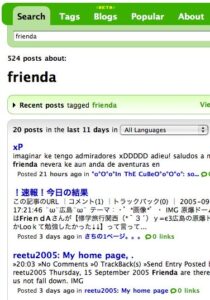
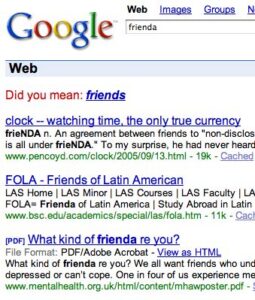
    Well, I searched for links to the article, or uses of the term, in a few of the obvious places. It’s been eight days, so I wouldn’t necessarily expect that web-wide indexes have been updated fully, especially for a random blog post. But my first search (surprise) was Google’s main web search, courtesy of the Safari search box, which saves removing fingers from the keyboard. And my post defining frieNDA came up first!?

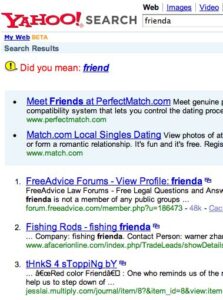
    So I followed up with Yahoo, MSN, and then Technorati. Only Google even had the post in its results. The big three all politely asked me if I meant to search for friend instead, a reasonable thought.

    Anyway, Google wins this one. Whether it’s a good thing for web search that one single post, apparently unlinked to, can shoot to the top of Google results is left for the audience to decide. Below are the four screenshots, all taken on the morning of September 21, 2005.

    Google

    Google search results for frienda - September 21 2005
    Google search results for frienda – September 21 2005

    Yahoo

    Yahoo search results for frienda - September 21 2005
    Yahoo search results for frienda – September 21 2005

    MSN

    MSN search results for frienda - September 21 2005
    MSN search results for frienda – September 21 2005

    Technorati

    Technorati search results for frienda - September 21 2005
    Technorati search results for frienda – September 21 2005
  • I have not fallen into this trap…yet

    Tim Bray shares what he’ll be doing on Saturdays: coaching a youth soccer team. I’ll spend my Saturdays attending similar “contests,” though I haven’t yet been conned into… I mean, graciously accepted… the offer to coach said team. Phew. (But I know it will happen.) Our group has a similar name to Bray’s, though someone threw the adjectives “Fierce” and “Little” before “Dragons.”

  • Why Software Sucks

    I’ve moved most of my straight linkblogging to del.icio.us (hate the URL, love the thoughtfulness of the directory structure), but it’s worth calling attention to Scott Berkun’s Why software sucks essay. There’s plenty to consider here, so only one nugget:

    … “this sucks” is right in the middle. In order for people to say “this sucks” they have to care enough about the thing you”ve made to spend time with it and recognize how bad it is.

    Every time a customer cares enough to tell us something is wrong, it’s an opportunity to earn their respect far into the future. At least they cared enough to tell you, instead of just leaving. Maybe they still leave, but perhaps you can fix the problem for the next person. That’s the goal, if not the promise.

  • Reuters podcasts… with a computer voice

    So Reuters opens a lab, and their first product is podcasts, read by a computer. I applaud them on introducing a public experimentation space, but the human voice has a future, at least for a bit longer.

    Compare the Reuters tech offering to Charlie Cooper and Leslie Katz in the News.com podcast, or Dan Farber and David Berlind in the Dan & David show on ZDNet. Yes, it’s easy to throw stones, but I don’t think I’m in a glass house on this one.

  • Orange is the color of money, or initial reactions to TimesSelect

    TimesSelect icon, large, from a skyscraper advertisementI’m not a visual design expert, but when I went to the NYT home page (which I do rarely, I realize) to look at TimesSelect, which was introduced yesterday, my reactions were to the visual presentation. More on that below.

    What is TimesSelect? Read the full details, including a well-presented comparison chart speaking well of the free NYTimes.com while still calling attention to the features of TimesSelect.

    However, the larger point is revenue diversification. After a decade on the free web (albeit registration required), NYTimes is reasserting that content has value. Will they be successful? To be determined. Of course, this might be too grand a goal to lay on the NYT… maybe it’s just a smart revenue mix opportunity. However, part of being the country’s (the world’s?) leading newspaper means having your every move watched like the Kremlin of old. Those on the outside interpret each small move as a possible industry bellwether. That probably makes the Times a tough place to experiment… maybe that’s why About.com is a helpful separate entity?

    My first impressions, starting at the home page, were… orange is now the color of money. The mark of premium content is an orange version of the site’s cursive capital T icon. New York Times favicon, in Safari Compared with the favicon, the TimesSelect icon looks cut off at the bottom? TimesSelect icon, small, for in-page usageAgain, I’m no designer, but why cut off the existing letter? The reversal of field (white cutout on an orange background) would have been enough for me. As to the color… beyond the icons next to the columnists, I noted three other uses of orange on the home page:

    • Navigation arrows for Job Market, Real Estate, Autos… in other words, classifieds, where there is certainly money to be made, and NYTD is making some.
    • A skyscraper (vertical ad banner) on the far right for TimesSelect, where I cropped the larger cut-off T.
    • Vonage ads in the left-hand navigation of the page. Ouch. This is most certainly just a coincidence, and it happens all the time on all websites.

    So orange = money. Fair enough. Hey, I work for a company whose corporate color is orange, so I’m predisposed to find it attractive.

    Side note: Who gets to be a visual design critic? Anyone with eyes! Doesn’t mean the critic is an expert, but that’s why those pictures get to replace a lot of words.

    As a legacy of my NewsTracker subscription, I have access to the TimesSelect material. The question will be whether in my normal reading patterns, I’ll find myself using/needing the service. I don’t follow the columnists, although I see that the sports columnists I do occasionally read are behind the wall, too. If I were still following the Yankees closely (where are you now, Craig Nettles?), I might care more.

    Just to try the service, I clicked on the link on the home page to Just Sports Business as Usual If the Saints Go Marching Out, by Harvey Araton. The annoying part? Even though I was logged in (member bar at top right showed my username), I was not taken to the article, but rather the upsell page for TimesSelect (specific to the article). It wasn’t until I went to the Member Center, and logged in to check my Transaction History (yup, I’m a subscriber converted from News Tracker) and then returned to the home page and clicked again that I was able to read the article. If you pay money, that’s not a happy thing. I expect the folks at NYTimes.com will sort it out, unless it was a deliberate effort to make me re-login… in which case I should have gotten specific messaging recognizing that I was logged in and explaining the reason for the extra hurdle. This is all in Safari 1.3.1 on Mac OS X 10.3.9, in case that’s useful/pertinent.

    I subscribe to a Times RSS feed for Tech; I depend on other people pointing to articles of interest for my other Times reading. That’s despite the fact that I deeply respect what the Times offers… but I have a print subscription to two newspapers, the San Francisco Chronicle and the Wall Street Journal. I can’t keep up, so I’ll drop the WSJ when it expires, even if I can continue to use airline miles to keep the papers coming. The Chronicle… well, it’s a quick skim: front page, comics, sports, with occasional reads of John King for architecture. But I digress…

    The point? I wouldn’t pay for the TimesSelect content right now, so the question is whether the services are strong enough. Services include: extra access to the archives, early access to the Sunday Times articles, Times File for bookmarking/saving NYT articles (and beyond, smart), multimedia (too early to put that stuff behind the wall, but maybe too early/small an audience to sell anyway), News Tracker (email alerts). As an early customer, News Tracker doesn’t have a lot of benefit you can’t find from free services, though perhaps it’s more convenient. So, I’d have to guess that the archive access is the true value in the mix… just hasn’t proven to be a need for me personally so far.

    Update: I started this post this morning, and finished it this evening. Today, the New York Times Company announced August 2005 results, which were not super. Separately, but also today, the company announced some layoffs, or, more accurately, provided details on its earlier warnings about staff reductions. The timing of the TimesSelect introduction cannot be coincidental — better to have something innovative (or at least new) to talk about.

    In closing: I want the Times to succeed, both as a reader and as a member of the media, albeit on the business/product side. Intelligent, timely, accurate information and analysis has value, so experiments in finding a new balance point for media businesses strike at the heart of what I care about, personally and professionally. I don’t know how TimesSelect will fare, but it’s a step to watch, if not follow.
  • Book: The Conquerors: Roosevelt, Truman and the Destruction of Hitler’s Germany, 1941-1945

    The Conquerors: Roosevelt, Truman and the Destruction of Hitler’s Germany, 1941-1945 has a misleading title. The book has a semi-interesting tale to tell about the debate within the American corridors of power about what to do with Germany after the war was won. Roosevelt, clearly, is a central character in that debate, but Truman, in this telling, is peripheral. Despite the title, the author, Michael Beschloss, focuses on Treasury Secretary Henry Morgenthau, who urged a punitive future for Germany.

    What happened to the Morgenthau plan? Well, do the words “Marshall Plan” mean anything to you? Morgenthau’s arguments didn’t prevail, and Germany recovered from the devastation of losing the war and 40+ years of division between East and West to become the third-largest economy in the world, according to a Wall Street Journal article I read last week (even if things aren’t rosy on the economic front there now). I guess Morgenthau in the title wouldn’t have sold many books.

    The writing is tolerable. However, Beschloss is so proud of his research that he overuses direct quotes, to the detriment of his narrative. The “you are there” style didn’t bring me anywhere close. In the preface, Beschloss notes that he started this book in 1992, and then put The Conquerors aside for several years to work on other projects. The author’s excitement about the additional historical archives made available due to the extra time didn’t pay off in a better history for this reader.

    (Peter, thanks for the book all the same. It didn’t make any life lists, but I did learn some things, despite my overall disappointment.)