Blog

  • Links to keep – January 15 2026

    I always come across interesting things, from various sources. Publishing them here occasionally as bookmarks for myself, at least. I did find in re-starting this blog that old links suffer from incredible rot, but I'm an optimist.

    Detailed story about American Samoans in Alaska being whipsawed by election law, which few involved even understand. The desire to tell a national story about election fraud (with few facts) leads to personal trauma for innocents: Americans by Name, Punished for Believing It.

    Where is Design Heading? is still in an open tab, not yet read, but written by someone with enough history (Mark Curtis) that I want this context. Part 2 promised in the future.

    “Type your postcode below to find out how confidently you can say you live in London.” Data-driven and yet still tongue-in-cheek. from James Darling. https://london.abscond.org/

    The Genius Whose Simple Invention Saved Us From Shame at the Gas Station is behind the WSJ paywall, but let’s recognize James Moylan (deceased) for adding an indicator to automobile instrument panels with an arrow for the gas tank side. So simple everyone followed, fortunately!

    Months old, but new to me: The Best Line Length is great because it’s both a TL;DR (88 characters is the answer given) and an exploration in more depth about why. This is nerdy internet at its best.

    Relax for the same result isn’t my typical approach to anything. Which is maybe why I needed to read this short note and I’m still thinking about it. Also, Derek Sivers has crafted lovely URLs for his work: https://sive.rs/relax

    We are living in a time of polycrisis. If you feel trapped – you’re not alone in The Guardian. Never heard the term polycrisis, but feels right. It may be hard to envision distant, positive outcomes amid a crisis, but that doesn’t mean they don’t exist. “We’d be foolish to stop planning,” said Hershfield. “We can still think about the values that are important to us and plan around them.”

    I recently finished Inventing the Renaissance by Ada Palmer, and learned a lot, and appreciated the rare academic-but-approachable tone. (Even if I got lost among all the names.) I have not yet read this blog post from 2013 that was recommended to me “The Borgias” vs. “Borgia: Faith and Fear” (accuracy in historical fiction) but posting here with ambition to finish.

    I’m deciding what to do about the link rot in my archive, so these words hit home from Introducing Revived: Breathing New Life Into Old Stories. More than one-third of web pages that existed in 2013 are no longer accessible. Between dead outlets and dead links, journalists too often get a 404 message when they navigate to stories they wrote years ago. Stories they were proud of. Stories that should have stood the test of time.

    Title says it all: EURASIA GROUP’S TOP RISKS FOR 2026 and the first one is already true. Risk 1: US political revolution Trump is attempting to dismantle checks on his power, capture the machinery of government, and weaponize it against his enemies, making the United States the principal source of global risk in 2026.

    Crowdsourcing project I may have known about at one time, but now I’m more curious than ever. “Help transcribe Library of Congress documents. Volunteers create and review transcriptions to improve search, access, and discovery of these pages from history.” By The People with the Library of Congress. Don’t know if I’ll waste (invest?) any time here, but if I’m going to be part of a Mechanical Turk, I’d do it for public data and information.

    Not new, but good list to use in pushing harder for what really matters. Extreme brainstorming questions to trigger new, better ideas includes ones I hadn’t seen before, such as “No tech support If you were never allowed to provide tech support, in any form, what would have to change?”

    Origin of the World Map is a fun seven-minute video about the Catalan Atlas, via Kottke linked from BlueSky. Maps rule.

    I barely overlapped with Zain Rivani at Cloudflare. I left the company a few months after Zain joined in 2016, after nearly six years. His historical note published in January 2026 rings true about the company, overall. Success comes from hiring people who give a shit regardless of their pedigree, then giving them something genuinely worth caring about: problems so complex they require second and third-order thinking and missions ambitious enough to seem impossible.

    Hiten Shah continues to publish and share and think in public. He’s still leading CrazyEgg (among other things). Since I help a few smaller organizations with their websites, I found this article useful How to Create a Website Using AI (From Start to Finish). Context: (1) Published January 8, 2026…some of the content is timeless, but some will age less gracefully (2) Despite the headline, the article is clear that “AI won’t do everything for you. You still need a solid website plan for your business.” (Of course, you can have AI help you plan…)

    San Francisco opportunities to help volunteer for focused cleanup efforts around the city, organized by CivicJoy. There’s also park cleanups.

    ~~~

    That’s more than enough for now.

  • Removing background from an image with Claude and ChatGPT

    Things have been quiet on my blog for years, but over the holidays, I cleared some cruft and did very light customization of the default template, which included adding an About page, with an image of your author.

    Getting the image to a satisfactory place took me far longer than expected. I’m a neophyte in AI tools and workflows, but I was starting with the visual equivalent of Hello World. Or so I imagined.

    Bottom line

    • Claude (Pro) completed the task, but I couldn’t see the output file. Reported bug, after trying in desktop app, Safari, and Chrome.
      • Original prompt: “Remove background from this image of a person wearing a red t-shirt with lettering on it.”
      • See the whole Claude chat if you want.
    • ChatGPT (free) didn’t work well at first, and went too far (see below), but one of the intermediate images is what I’ve published on the About page.
      • Original prompt: “remove background from this image”
      • See the whole ChatGPT chat if you want.

    I’ll walk backwards through the process because I was surprised this took so long, and images are mildly amusing.

    Final published version, 1 January 2026

    Yes, it’s a PNG where I haven’t filled the transparency with a color. I may fix that in the future on the About page, so I’ll keep this as an artifact here.

    Picture of author, cropped from another photo.

    Original

    The crop I started with, as a JPG.

    Original image of author, cropped from another image, before removing background.

    Claude attempt

    Nothing to show; that’s the bug. Something to do, probably, with present_files or thereabouts. With no output visible I can’t judge the effort.

    ChatGPT first try – Polar Express?

    I hated this. The entire prompt was “remove background from this image” but somehow the default output was to do more, with a Polar Express vibe.

    Terrible first file output from ChatGPT, going beyond the prompt.

    ChatGPT second try – abstract art?

    My response: “That’s terrible. I wanted the existing image as is, without the background. Don’t alter the rest of the image.”

    This was wrong in entirely different ways.

    ChatGPT 2nd attempt; missed the mark in weird ways.

    My feedback: “That’s not what I expected. The original image is of a man with a red t-shirt with white lettering, in front of another person, obscured in the background. The output you shared removes far more than the background, and altered the colors.”

    ChatGPT third try – not sure anything happened

    The more conservative attempt didn’t change anything. Not useful.

    ChatGPT went conservative but didn't meet the goal at all

    ChatGPT fourth try – worked

    The response that accompanied the third try was long-winded and gave me several options to improve the outcome, and I chose this one (ChatGPT wording):

    Remove the person behind him instead
    This can be done cleanly and predictably.

    The outcome from that option is what I decided to use. You can see it above. I gave this feedback in chat.

    “This image matches my goal with the original prompt.”

    ChatGPT fifth try – regression!

    Despite my approval, ChatGPT recommended one more try, to improve, and asked me to make one more choice. I chose “A) Transparent background” from the options.

    ChatGPT offer to improve the image with more try.

    And, we’re back to abstract art. (At least my face isn’t blue?)

    Not an improved image of the author. "Transparent background" selection went awry.

    That’s enough.

  • Links to keep – May 11 2019

    One way to inbox zero is to take the links I’ve emailed myself and save them somewhere. This trio is all work related.

    Only sadness is that two of these links go to Medium.

  • TLD worth the purchase – .app

    I’ve limited my domain purchases in recent years, and even let some of my bought-on-a-whim domains go (wordplumbr.com) after years of paying for renewals without using them.

    But I still went ahead with the purchase of pencoyd.app when Google opened up that new TLD.

    No specific plans for the new domain, so for now, I’ll link it to this post. I’ll leave the other 1,500+ possibilities alone.

  • Gantlet

    I did a double-take when I saw today’s New York Times headline “A Big Step in Roger Federer’s Comeback, but a Gantlet Awaits Him” because I always thought the correct word is gauntlet.

    But I learned something new today, courtesy of Grammarist.

    Gantlet was the original spelling of the word referring to a form of punishment in which people armed with sticks or other weapons arrange themselves in two lines and beat a person forced to run between them.

    Both words are accurate, with slightly different contexts, although often used interchangeably now. The New York Times, of course, used the word properly.

    Am I done learning today? Hope not.

  • WhiteHouse.gov archives are a small positive step in preserving digital history

    As a new administration prepares to take office this month, I’m concerned about attempts to rewrite history.

    The President-Elect is notably inconsistent in his opinions and stances over the years. And, in the few years he’s been on Twitter, he’s taken to deleting any inconvenient past posts. At the state level, in Wisconsin, Governor Scott Walker’s administration is removing mentions of climate change from a state Department of Natural Resources website about (ahem) how the agency “would deal with warming planet.”

    WhiteHouse.gov

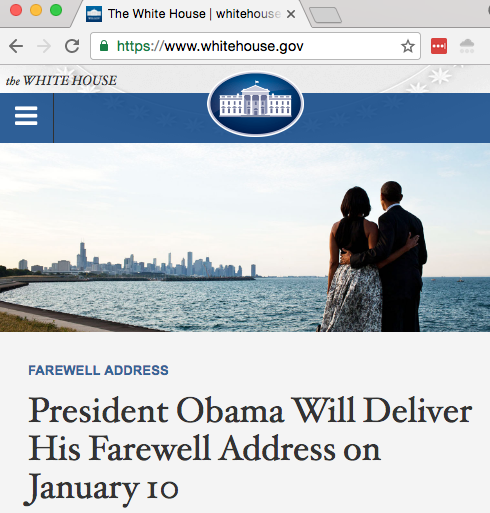
    Screenshot of WhiteHouse.gov on January 4, 2017
    Screenshot of WhiteHouse.gov on January 4, 2017

    All of which made me wonder about the history of WhiteHouse.gov. After literally wondering about this in the middle of the night, I researched enough to be able to sleep easier (on this front) going forward.

    Digital history is being preserved, however imperfectly, and our responsibility as citizens to learn from our past enjoys a firm foundation.

    The Obama Administration published a detailed guide to its digital transition, before the election. Here’s the section focusing on WhiteHouse.gov:

    “Similar to the Clinton and Bush White House websites, President Obama’s WhiteHouse.gov will be preserved on the web and frozen after January 20th and made available at ObamaWhiteHouse.gov. The incoming White House will receive the WhiteHouse.gov domain and all content that has been posted to WhiteHouse.gov during the Obama administration will be archived with NARA.”

    The first public website for the White House was developed in 1994, during the Clinton administration. As noted in the quote above, the National Archives have versions of the Clinton website, both the final version and final version, but impressive collection of other versions and other historical documents is found within the Clinton Digital Library, with links to official government hosting. The final WhiteHouse.gov from George W. Bush, too, is hosted officially by the government at https://georgewbush-whitehouse.archives.gov/.

    In a smaller vein, the current White House keeps public versions of its privacy policy changes over time, although that page goes back only to February 26, 2010, within a single administration. We’ll see if version control and public accountability continues.

    Other federal government digital data

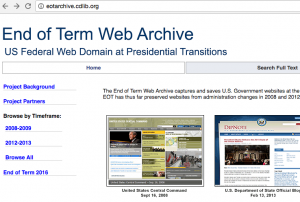
    I’m not surprised, but still pleased: the Internet Archive is leading a comprehensive effort across all U.S. government websites. More details on the project were published on December 15, 2016, but the goal is to make the End of Term Web Archive a comprehensive resource for all. (Note: HTTPS is not supported on the End of Term Web Archive, currently. Sigh.)

    History and (even better) version control for laws and public documents of all kinds makes sense and helps us hold each other accountable over time. That doesn’t mean it’s easy, so I’ve made a small donation to the Internet Archive, inspired by what they’ve already achieved and to support more work here. You can donate, too.

    Preserving my own digital history

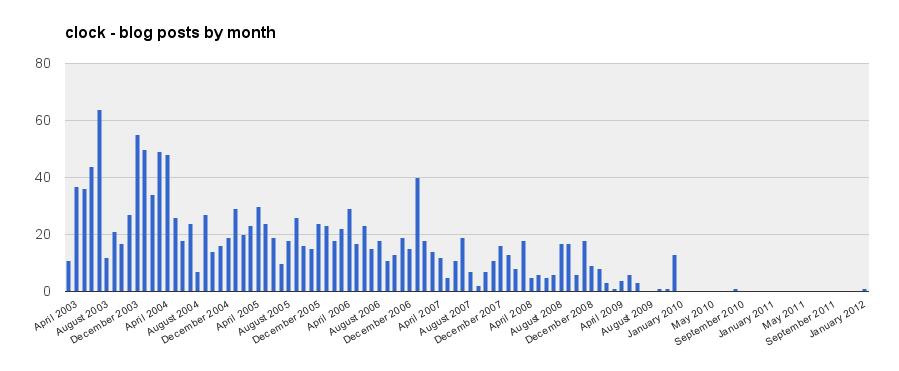
    I’m drawn to this subject not simply because of political shenanigans or concerns over how America holds itself accountable during the coming years, but because on a personal level I’m working to rehabilitate my previous years of blogging, currently offline in a WordPress XML archive. From March 2003 to January 2012, I published 1,465 posts at http://www.pencoyd.com/clock which are currently offline. I’m working on resurrecting that archive next. I’ll use https://clock.pencoyd.com/ as the blog home going forward.

    Click for full version

    Small irony, given my past work life: I needed to allow web.archive.org as a Proxy/Anonymizer in my OpenDNS parental controls to view the old versions of my blog.

  • Happy 28th to Ma.tt

    Enjoyed cheering Matt on tonight as he turned 28 and seeing various other friends. More broadly, this celebration reminded me that sitting in my inbox (for too long now) are plans to re-start my own chronicle, right here with my WordPress install. Lots of other living to do, but I miss writing, too.

  • Smart reminder option from ULINE.com

    I made a purchase of some shipping boxes from ULINE.com today. There’s a nice touch, captured in this screenshot: an opt-in for getting an email reminder to repeat this order in the future. Set to one month in the future, the date is easily configurable. Well done, especially for a site that sells consumables.

    Smart email reminder checkbox from ULINE

    I didn’t set a reminder, despite my appreciation of the design.

  • Book: Pirate

    I should be ashamed to admit that I read Ted Bell’s Pirate. And I am, mildly. Still, I bounce around in my reading, and candy has its place among the food groups, too (or something like that). If I’m going to record the books I’ve read, I want to capture all of it. I certainly don’t want to make the mistake of reading this one again. A weak James Bond wannabe tale, Pirate doesn’t have much beyond the clichés. Oh well. I won’t pick up any of Bell’s other single-word titles.

    (This is part of my end-of-the-year rush to capture my major media consumption before the year actually comes to a close.)

  • Book: The Devil in the White City

    The Devil in the White City by Erik Larson lay around the house for years before I read it this summer.

    The subtitle “Murder, Magic and Madness at the Fair That Changed America” underlines the book’s strength and weakness. Larson is telling two stories, and I found his weaving a bit crude and forced. The first story, the history of the 1893 Columbian Exposition from inspiration to remarkable execution, fascinated me. The second story, bringing to life an early serial killer, is all too modern, despite the late 19th century Chicago setting. The urban growth goosed by the Exposition may have also given the murderer an increasing supply of victims, but I didn’t find them more than coincidental.

    As a side note, which reinforces the point, Larson plays with the story of the Exposition’s main attraction. I didn’t know the Ferris wheel came from the 1893 fair, as a response to the Eiffel Tower of the last world fair. It sounds remarkable, but teasing out the punchline made the story a bit too much of a gotcha, as if Larson were revealing the #1 hit in a countdown of the year’s best.

    Telling a great popular history is nothing to be ashamed of. Larson didn’t need to tart up the tale with a police procedural. Despite my concerns over the competing stories, I enjoyed the event enough that this general topic remains on my “to read” list.

    (This is part of my end-of-the-year rush to capture my major media consumption before the year actually comes to a close.)