Category: Uncategorized

  • $8.50 for 17 miles = didn’t seem worth it

    We spent the weekend down the California coast, kid-free (thanks, Laura!). Route 1 enchanted, Hearst Castle’s extravagance boggled, and running on our own schedule refreshed. I should write up the hotel for HotelChatter.com, but not tonight. After driving Route 1, learning that the 17 mile drive costs $8.50 was an unpleasant surprise. We decided 90 free miles (twice!) on Route 1 between Carmel and San Simeon made up for whatever we might miss in the most famous stretch. If that was the wrong decision, let me know. It’s close enough that we’ll do it again, or maybe I’ll take a kid or two down to the Monterey Aquarium.

    We did pay nearly $3.80/gallon for some gas near Gorda… makes the rest of California seem almost as cheap as Texas! Ouch.

  • Book: The Hundred Days

    I finished Patrick O’Brian’s The Hundred Days a few weeks ago, and I don’t have the energy to spend much time commenting on it now. I’m knee deep in my next book (think Stephenson), and work has been busy. Anyway, this is #19, and I’ve only got one more left in the Aubrey-Maturin series. Too bad for me. How far along are you?

  • Links: November 9, 2004

    Time to clear out the Safari bookmarks bar once more.

    Until the clutter drives me mad again…

  • Book: Hackers & Painters: Big Ideas from the Computer Age

    A favorite of the Slashdot crowd, Paul Graham takes time to craft his words in ways which make my synapses smile. Many of the essays in his book Hackers & Painters: Big Ideas from the Computer Age essays have appeared online previously. I’ve noted a couple before. The book collects fifteen essays, all springing from thoughts on technology or experience as a technical wizard in a world which has increasingly rewarded those skills. But the insights are not limited to the realm of computing. There are individual essays (chapters) here that I want my wife and others to read, both because I wish I could write like this (and think like this?) and because I agree so wholeheartedly with many of the insights. I like to imagine myself as a leading edge, or an early adopter, but I’m not blazing a trail that I know of… I’m just paying attention to a strange subculture which (I believe) is showing the world of the future a few years early. Graham is even further out, both explaining parts the past and maps the future. He prescribes. That’s bold, because you can be wrong. You have to risk being wrong to do something great. The words in this book, at least, are great.

    For others, substitute yourself. You can read most of (all? I can’t be bothered to check) the essays on Graham’s website if you want to get a sampler before diving in on the inexpensive purchase. Or you can just trust me and read the book.

  • Cool costumes and candy, what Halloween is all about

    The days leading up to Halloween are a crescendo of excitement with young children in the house. As witness, I offer the following, overheard three mornings before the costumed, candy-filled parade. The boy is talking to his sister (who doesn’t yet reply):

    If we don’t get any sleep, we can’t go trick or treating, so we have to go to sleep.

    All this at 7am, when both kids would normally be awake anyway. Everyone was out of bed and going the usual (high) speed within ten minutes, when the boy realized the girl wasn’t listening to his entreaties to go back to sleep.

    For the big event, the boy dressed as Batman. I decided to be Robin, the (much bigger than Batman) Boy Wonder. I enjoyed assembling the costume from odds and ends grabbed at Mervyn’s on Sunday afternoon, and I think it went well.

    Prior to the morning warning, the boy had asked his mother what she was going to be for Halloween. She told him she was going to be a mommy. The boy replied:

    I don’t want you to be a mommy. I want you to be something cooler.

    I don’t think that falls under the category of well-expressed gratitude for years of making one’s wishes subservient to one’s children’s. But it was funny.

  • How prescient was William Gibson?

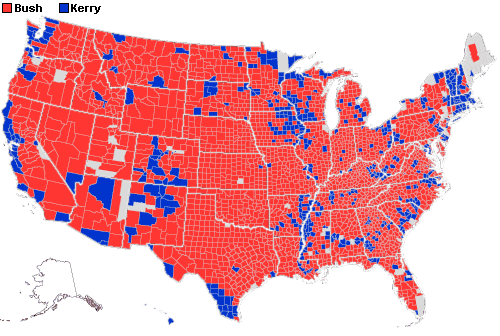
    Northern California isn’t yet a separate nation-state, or economic superpower… although California as a whole is. But with all the different versions of a imagined geographies appearing around the web, you have to wonder if NoCal, as envisioned by William Gibson in Neuromancer (among other novels), will ever find a new place in the country or the world. Here’s the real breakdown of the way it is, courtesy Scripting News. Or, the national 404 (read closely).

    Living in San Francisco, where a Democratic mayor was the conservative candidate in the last election, really doesn’t prepare you for the real world of national politics. It’s obvious, intellectually, but that dichotomy of colors… wow.

  • Which link got more clicks?

    So Scoble points to both CNET News.com and Engadget for articles about the new Gateway MP3 player. I wonder which got more clicks?

  • Email is a stack

    Jeremy Zawodny asks “Is your email inbox a stack or a queue?” In simpler, less geeky terms… do you sort so new messages show up on top (stack) or bottom (queue) of your inbox?

    I’m all about the stack, both at work (Outlook) and at home (Mail). First, I like to know what’s new and scan to see if I should react. Second, if the inbox gets full enough that I can’t see both the oldest message and the newest, I want to prune.

    Old messages are there because the inbox is a to-do list. I’ve tried alternate methods for handling priorities, because chronology really isn’t the best method, but email continues to be the application where I spend most of my time.

    My wife treats email as a queue. I never thought to ask why, but I will.

    Spread the meme, either by commenting on Jeremy’s blog or blogging yourself and tracking back.

  • Number 1 for something, at least

    So, in reading Neil Turner, I learn about Silktide’s SiteScore. Free tool for analyzing your website on usability, popularity, and other metrics… both qualitative and quantitative. Like everyone else, I wanted to know where I stacked up, so www.pencoyd.com/clock went under the magnifying glass. The score? 6.4. Of course, the design got a 9.0, which is no credit to me (I used a default Radio template) and a poor comment on the ratings, since it’s oh-so-plain. Still, I learned something interesting: this site is the first result for a Google search for watching time. I can’t imagine that’s a common search, but doesn’t everyone want to win something? And I’m never going to be the first John Roberts in Google, so I’ll take this tiny stake on the web.

    And I’m #6 for books currently waiting.

  • Book: The Yellow Admiral

    Now, in addition to the pile of books upstairs waiting to be read, I have a (smaller) stack of books next to the computer waiting to be blogged. Time to knock the pile down by one volume, with number 18 in the Aubrey-Maturin series, The Yellow Admiral.

    As it’s been a few weeks, I will only call out two elements of the story, very little of which takes place at sea.

    The first is the remarkable description — without dropping into a lecture — of the battle over enclosures. This practice of combining smaller parcels of land, and removing the commons (yes, see “tragedy of the…”) from, well, common usage was both a political and financial tool for the powerful, concentrating wealth and power — usually in that order — and pushing more and more of the populace from agricultural work to industrial efforts. Enclosures helped changed the face of England in the 19th century. I’ve studied English history, but never found that the boring, yet vital, details of this shift in land-ownership and usage stuck with me. But O’Brian helped enormously, and makes Aubrey an opponent, successful in this single instance in stemming the tide of concentration. Aubrey is, while ashore, a landed MP, though quite cash poor in the period this book covers, so his vote still matters more than his pocketbook. Maybe the dialogue wouldn’t have filled in all the gaps if I hadn’t somewhere remembered pieces of the historical puzzle — but I bet I would have learned the import of the facts much faster if I’d had started with fiction like this back in the day when knowing these things actually mattered, or seemed to. Ahhhh… college.

    The second part of the story I recall most vividly is that Jack Aubrey’s mother-in-law finds an old stack of love letters from his dalliance in Canada early in his marriage. Sophie kicks him out of the house, and it’s only late in the book that tempers and the marriage are returned to an even keel. Combination of a shrewish, curious mother-in-law with documented evidence of infidelity makes Jack a dull (as in thick) boy. Whoops.